In a significant move in January 2022, the Ministry of Finance in the United Arab Emirates (UAE) announced the introduction of Corporate Tax in UAE, with the law set to be in effect from the 1st of June 2023. This paves a new way for businesses to understand and navigate taxation in the UAE, providing an opportunity for economic growth and stability in the country.
While corporate taxation is not a novelty in the world economy, with countries such as the US, India, and France, along with other GCC nations like Oman, Kuwait, and Qatar, having well-established corporate tax regimes, it’s a fresh narrative in the UAE business scene. What’s more interesting is that the UAE has emerged with the lowest corporate tax rate globally at 9%, making it an attractive business hub.
The Federal Tax Authority will administer, collect, and enforce UAE’s Corporate Tax. At the same time, the Ministry of Finance will maintain its authority for bilateral or multilateral agreements and the global exchange of tax-related information.
Let’s delve deeper and understand what implementing Corporate Tax signifies for businesses in the UAE and beyond.
Table of Contents
ToggleA Shot in the Arm for UAE Economy
The Corporate Tax is seen as a tool to strengthen the UAE’s economic position, bolster corporate governance, and speed up its strategic economic transformation, much like a bullet train moving rapidly toward its destination.
Furthermore, the introduction of Corporate Tax places the UAE firmly on the world map as a leading business hub. It showcases the country’s commitment to adhering to international tax transparency standards and combating unauthorized tax practices, thus accelerating national development.
Unravelling the Tax Exemptions
While businesses exceeding the threshold of 3,75,000 AED are subject to corporation tax, some income categories are immune to it. Notable exemptions include real estate, share investments, and personal income unrelated to a business operation. Foreign investors are also exempted. Existing corporate tax benefits will continue for free zone businesses that comply with all regulatory conditions.
Understanding the Tax Landscape: Who Pays What?
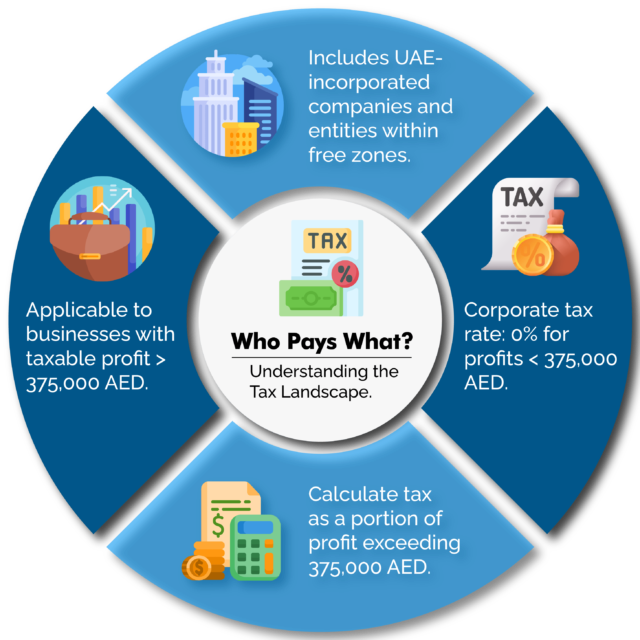
The corporate tax in UAE applies to all businesses with a taxable profit exceeding 375,000 AED, requiring them to pay a portion of their net profit as corporate tax. This includes companies incorporated or managed in the UAE and entities within a free zone. The corporate tax rate will be 0% for net profits less than 3,75,000 AED to support small businesses and startups.
Simply put, for a net profit of 5,75,000 AED, the corporate tax will be 18,000 AED [(5,75,000 – 3,75,000) X 9/100].
Demystifying Deductibles and Non-Deductibles
In corporate tax, certain expenses following general accounting rules are non-deductible, necessitating their addition to the accounting income to calculate the Taxable income. Examples include depreciation or amortization expenses for Capital Assets, business setup, license renewal, and other government fees paid primarily for business purposes.
On the flip side, some expenses are non-deductible, designed to prevent abuse or excessive deductions, and ensure that only expenses necessary to generate taxable income are eligible for relief.
Keeping the Books Straight
To adhere to the new tax regulations, UAE businesses must maintain comprehensive financial records for tax returns. This will be crucial in ensuring corporate tax compliance and assisting the Federal Tax Authority (FTA) in verifying the company’s exempt status.
From trade license copies to contact information, businesses need to be prepared with relevant documentation for successful Corporate Tax Registration in the UAE.
Decoding UAE's Small Business Tax Relief
The Small Business Relief program introduced as a part of the new Corporate Tax in UAE regulations can be a boon for startups and early-stage businesses. The program offers a 3-year exemption from corporate tax, providing these businesses a cushion further to develop their operations without tax obligations.
However, as Dr. Nabeel Ahmed, Partner at DVS Management Consultancy, points out, businesses must consider the impact on other corporate tax provisions such as ‘tax loss relief’ and interest expenditure. As these cannot be carried forward to subsequent tax periods, businesses should conduct a ‘cost-benefit analysis’ to determine whether claiming relief or opting for a loss set-off in anticipation of higher revenues and profits in the future would be a better business decision.
The Corporate Tax in UAE laws allow businesses to spread their payments over multiple years based on their interest expenditure, among other things. These nuances in the tax law are critical factors that SME owners and their auditors should weigh when making tax-related decisions.
Regardless of their choice for the relief package, small businesses must register with the Federal Tax Authority under the new tax law. This stipulation and the potential tax incentives for SMEs with turnover under Dh3 million provide these businesses the much-needed flexibility to scale up operations.
However, experts suggest that the tax relief program is most beneficial for startups and early-stage businesses in the expansion phase, with sizable capital expenditure planned for the next three years. These businesses can focus on growth without additional taxes during the relief period from June 1, 2023, to December 31, 2026.
Therefore, SMES must adopt a strategic approach when considering the Small Business Relief package, analyzing their unique situation and projected growth before deciding.
Embracing Free Zones
The Corporate Tax Law introduces a “Qualifying Free Zone Person” (QFZP), defined as a free zone company or branch with adequate substance in the UAE, eligible income, transfer pricing requirements met, and other conditions as per ministerial decisions. A QFZP may forgo the 0% tax regime and pay the regular CT rate.
Conclusion
The Corporate Tax in UAE Law is a bold step forward for the UAE, demonstrating its commitment to meeting international tax standards while fostering a conducive environment for business growth. As the UAE continues to pioneer its strategic economic transformation, businesses within its borders and those considering expansion can rest assured of a promising, tax-efficient landscape primed for growth and innovation.